
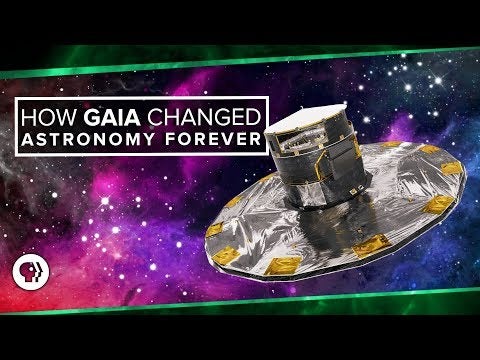
How Gaia Changed Astronomy Forever
About this episode
Viewers like you help make PBS (Thank you 😃) . Support your local PBS Member Station here: https://to.pbs.org/DonateSPACEUploaded 09-05-18The great advances in any science tend to come in sudden leaps. April 25th of 2018 marks the beginning of just such a leap for much of astronomy. In the early hours of the morning, the Gaia mission’s second data release dropped. Our understanding of our own galaxy will never be the same again.You can further support us on Patreon at https://www.patreon.com/pbsspacetimeGet your own Space Time t-shirt at http://bit.ly/1QlzoBiTweet at us! @pbsspacetimeFacebook: facebook.com/pbsspacetimeEmail us! pbsspacetime [at] gmail [dot] comComment on Reddit: http://www.reddit.com/r/pbsspacetimeHelp translate our videos!https://www.youtube.com/timedtext_cs_panel?tab=2&c=UC7_gcs09iThXybpVgjHZ_7gPrevious Episode:The Star at the End of Timehttps://www.youtube.com/watch?v=-iWGtQ03OZMThe Gaia satellite was launched in late 2013, entirely built and operated by the European Space Agency. It’s primary goal is to map the stars of the Milky Way with a scale and precision orders of magnitude greater than ever before. Gaia’s predecessor, Hipparcos, catalogued 120 thousand stars, Gaia blows it out of the water with positions, colors and brightnesses of nearly 1.7 billion stars. Gaia can see orders of magnitude fainter and further away than previous missions. But its greatest superpower is its precise astrometry – Gaia can pin down a star’s position to the equivalent of a human hair’s width at 1000 km. That’s one-to-two thousand times smaller than the resolution of the Hubble Space Telescope. Hosted by Matt O'DowdWritten by Drew Rosen and Matt O'DowdGraphics by Grayson BlackmonAssistant Editing and Sound Design by Mike Petrow and Linda HuangMade by Kornhaber Brown (www.kornhaberbrown.com)Special thanks to our Patreon Big Bang, Quasar and Hypernova Supporters: Big BangCoolAsCatsDavid NicklasAnton LifshitsJoey RednerFabrice EapQuasarTambe BarsbayMayank M. MehrotaMars YenturMark RosenthalDean FuquaRoman PinchukColeslawPurdieHypernovaEdmund FokschanerMatthew O’ConnorEugene LawsonBarry HatfieldMartha HuntJoseph SalomoneChuck ZegarCraig PetersonJordan YoungRatfeastJohn HofmannThanks to our Patreon Gamma Ray Burst Supporters: James HughesFabian OlesenKris FernetJane MeyersJames FlowersGreg AllenDenys IvanovNick VirtueAlexey EromenkoNicholas RoseScott GossettMark VasilePatrick MurraySultan AlkhulaifiAlex SetoMichal-Peanut KarmiErik SteinKevin WarneJJ BagnellAvi GoldfingerJohn PettitFlorian StinglmayrBenoit Pagé-GuitardNathan LenizBrandon LabonteDavid CraneGreg WeissShannan CatalanoBrandon Cook Learn more about your ad choices. Visit megaphone.fm/adchoices
Learn more about your ad choices. Visit megaphone.fm/adchoices
More from PBS Space Time
PBS Member Stations rely on viewers like you. To support your local station, go to:http://to.pbs.org/DonateSPACE Sign Up on Patreon to get access to the Space Time Discord! https://www.patreon.com/pbs…
Take the Space Time Fan Survey Here: https://forms.gle/wS4bj9o3rvyhfKzUAUploaded 23-02-22PBS Member Stations rely on viewers like you. To support your local station, go to:http://to.pbs.org/DonateSPAC…
Sign Up on Patreon to get access to the Space Time Discord!https://www.patreon.com/pbsspacetimeUploaded 15-09-21We’ve traveled to lots of weird places on this show - from the interiors of black holes…
Viewers like you help make PBS (Thank you 😃) . Support your local PBS Member Station here: https://to.pbs.org/DonateSPACEUploaded 19-07-17Anti-Satellite weaponry, giant X-ray lasers and kinetic impact…
PBS Member Stations rely on viewers like you. To support your local station, go to: http://to.pbs.org/DonateSPACE↓ More info below ↓Uploaded 12-01-21Erratum: Figures in episode should be Minev et al.…