
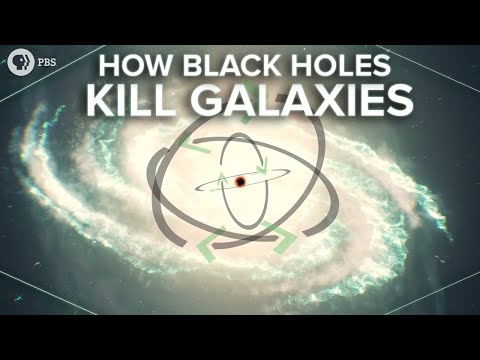
How Black Holes Kill Galaxies
About this episode
To learn to think like a scientist check out http://Brilliant.org/SpaceTimeUploaded 17-06-19PBS Member Stations rely on viewers like you. To support your local station, go to: http://to.pbs.org/DonateSPACECheck out the new Space Time Merch Store!https://pbsspacetime.com/Support Space Time on Patreonhttps://www.patreon.com/pbsspacetimeBlack holes are really only dangerous if you get too close. Ha, who am I kidding. It turns out they may be responsible for ending star formation across the entire universe.Hosted by Matt O'DowdWritten by Matt O'DowdGraphics by Leonardo ScholzerDirected by Andrew KornhaberProduced By: Kornhaber BrownWhen we first realized that black holes could have masses of millions or even billions of times that of the sun, it came as a bit of a shock. They were discovered as the driving force behind quasars, where matter is heated to extreme incandescence before its plunge into vast black holes. But if that weren’t enough, we soon realized that every single decent-sized galaxy contains such a supermassive black hole. By the beginning of the 21st century it became clear that black holes and the galaxies that contain them are very closely connected. The bigger the galaxy, the bigger its supermassive black hole. That might not sound surprising. What was weird was how closely they were connected. There’s a tight correlation between the mass the central black hole and the mass of the stars in the galactic bulge – that’s the central ball-like part of a spiral galaxy, or the entirety of an elliptical galaxy, and every bulge contains a supermassive black hole around one-one-thousandth its mass. And there’s an even tighter relationship between the black hole mass and the speed that stars are moving in their random orbits within the galactic bulge – the so-called stellar velocity dispersion – which itself depends of the total mass of the galaxy, including dark matter.Big Bang Supporters:Anton LifshitsDavid NicklasFabrice EapJuan BenetJustin LloydQuasar Supporters:Mark HeisingMark RosenthalTambe BarsbayVinnie FalcoHypernova Supporters:Chuck ZegarDanton SpiveyDonal BotkinEdmund FokschanerHank SJohn HofmannJohn R. SlavikJordan YoungJoseph SalomonekkmMark HeisingMatthewMatthew O'ConnorSyed Ansar Gamma Ray Burst Supporters: Adrien HatchAlexey EromenkoAndreas NautschBradley JenkinsBrandon LabonteCarlo MogaveroDaniel LyonsDavid BehtalaDFaulkDustan JonesGeoffrey ShortJames FlowersJames QuinteroJohn FunaiJohn PollockJonahJonathan NesfederJoseph DillmanJoseph EmisonJosh ThomasKevin WarneKyle HoferMalte UblMark VasileNathan HitchingsNick VirtuePaul RoseRyan JonesScott GossettSigurd Ruud FrivikTim JonesTim StephaniTommy MogensenYurii Konovaliukسلطان الخليفي Learn more about your ad choices. Visit megaphone.fm/adchoices
Learn more about your ad choices. Visit megaphone.fm/adchoices
More from PBS Space Time
Viewers like you help make PBS (Thank you 😃) . Support your local PBS Member Station here: https://to.pbs.org/DonateSPACEUploaded 08-03-17You’ve discovered a habitable exoplanet, but so has an an evil…
Viewers like you help make PBS (Thank you 😃) . Support your local PBS Member Station here: https://to.pbs.org/DonateSPACEUploaded 26-07-17Unlock the secrets of Feynman Diagrams. Part 5 in our Quantum…
Viewers like you help make PBS (Thank you 😃) . Support your local PBS Member Station here: https://to.pbs.org/DonateSPACEUploaded 04-07-18Thanks to Curiosity Stream for supporting PBSDS. You can get t…
Sign Up on Patreon to get access to the Space Time Discord!https://www.patreon.com/pbsspacetimeUploaded 18-08-21The universe is going to end. But of all the possible ends of the universe vacuum decay…
You can learn more about CuriosityStream at https://curiositystream.com/spacetimeUploaded 01-05-19PBS Member Stations rely on viewers like you. To support your local station, go to: http://to.pbs.org/…