
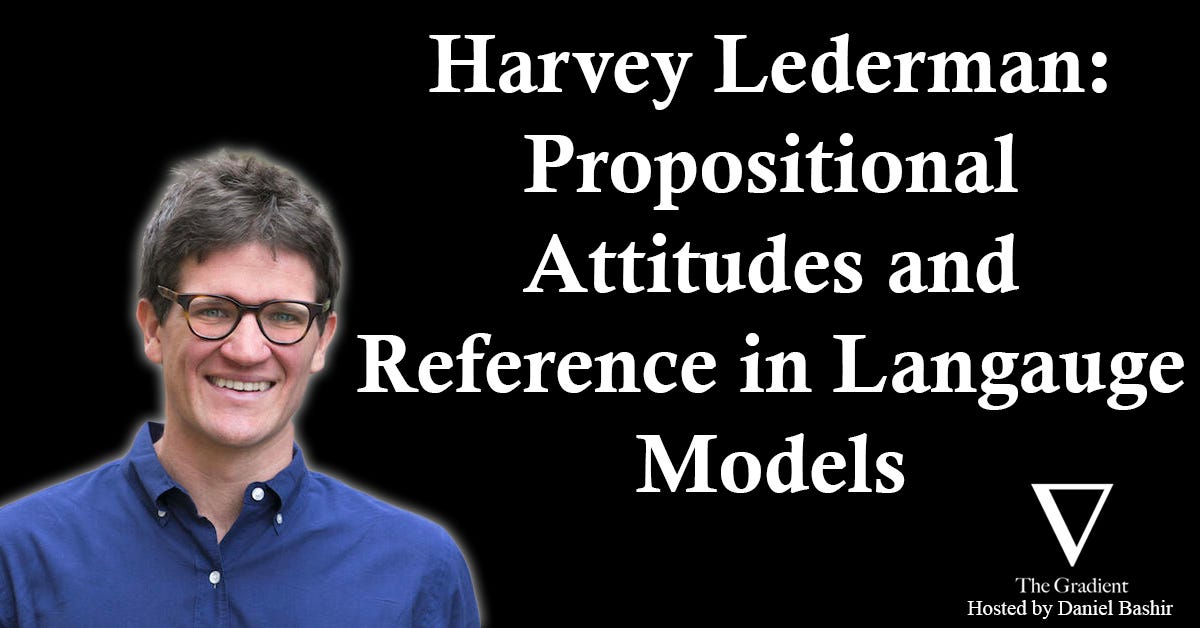
Harvey Lederman: Propositional Attitudes and Reference in Language Models
About this episode
In episode 106 of The Gradient Podcast, Daniel Bashir speaks to Professor Harvey Lederman.
Professor Lederman is a professor of philosophy at UT Austin. He has broad interests in contemporary philosophy and in the history of philosophy: his areas of specialty include philosophical logic, the Ming dynasty philosopher Wang Yangming, epistemology, and philosophy of language. He has recently been working on incomplete preferences, on trying in the philosophy of language, and on Wang Yangming’s moral metaphysics.
Have suggestions for future podcast guests (or other feedback)? Let us know here or reach us at [email protected]
Subscribe to The Gradient Podcast: Apple Podcasts | Spotify | Pocket Casts | RSSFollow The Gradient on Twitter
Outline:
* (00:00) Intro
* (02:15) Harvey’s background
* (05:30) Higher-order metaphysics and propositional attitudes
* (06:25) Motivations
* (12:25) Setup: syntactic types and ontological categories
* (25:11) What makes higher-order languages meaningful and not vague?
* (25:57) Higher-order languages corresponding to the world
* (30:52) Extreme vagueness
* (35:32) Desirable features of languages and important questions in philosophy
* (36:42) Higher-order identity
* (40:32) Intuitions about mental content, language, context-sensitivity
* (50:42) Perspectivism
* (51:32) Co-referring names, identity statements
* (55:42) The paper’s approach, “know” as context-sensitive
* (57:24) Propositional attitude psychology and mentalese generalizations
* (59:57) The “good standing” of theorizing about propositional attitudes
* (1:02:22) Mentalese
* (1:03:32) “Does knowledge imply belief?” — when a question does not have good standing
* (1:06:17) Sense, Reference, and Substitution
* (1:07:07) Fregeans and the principle of Substitution
* (1:12:12) Follow-up work to this paper
* (1:13:39) Do Language Models Produce Reference Like Libraries or Like Librarians?
* (1:15:02) Bibliotechnism
* (1:19:08) Inscriptions and reference, what it takes for something to refer
* (1:22:37) Derivative and basic reference
* (1:24:47) Intuition: n-gram models and reference
* (1:28:22) Meaningfulness in sentences produced by n-gram models
* (1:30:40) Bibliotechnism and LLMs, disanalogies to n-grams
* (1:33:17) On other recent work (vector grounding, do LMs refer?, etc.)
* (1:40:12) Causal connections and reference, how bibliotechnism makes good on the meanings of sentences
* (1:45:46) RLHF, sensitivity to truth and meaningfulness
* (1:48:47) Intelligibility
* (1:50:52) When LLMs produce novel reference
* (1:53:37) Novel reference vs. find-replace
* (1:56:00) Directionality example
* (1:58:22) Human intentions and derivative reference
* (2:00:47) Between bibliotechnism and agency
* (2:05:32) Where do invented names / novel reference come from?
* (2:07:17) Further questions
* (2:10:04) Outro
Links:
* Harvey’s homepage and Twitter
* Papers discussed
* Higher-order metaphysics and propositional attitudes
* Sense, Reference, and Substitution
Get full access to The Gradient at thegradientpub.substack.com/subscribe
More from The Gradient: Perspectives on AI
Episode 144 Happy New Year! This is one of my favorite episodes of the year — for the fourth time, Nathan Benaich and I did our yearly roundup of AI news and advancements, including selections from th…
Episode 143 I spoke with Iason Gabriel about: * Value alignment * Technology and worldmaking * How AI systems affect individuals and the social world Iason is a philosopher and Senior Staff Research S…
Episode 142 Happy holidays! This is one of my favorite episodes of the year — for the third time, Nathan Benaich and I did our yearly roundup of all the AI news and advancements you need to know. This…
Episode 141 I spoke with Professor Philip Goff about: * What a “post-Galilean” science of consciousness looks like * How panpsychism helps explain consciousness and the hybrid cosmopsychist view Enjoy…
Hi everyone! If you’re a new subscriber or listener, welcome. If you’re not new, you’ve probably noticed that things have slowed down from us a bit recently. Hugh Zhang, Andrey Kurenkov and I sat down…