
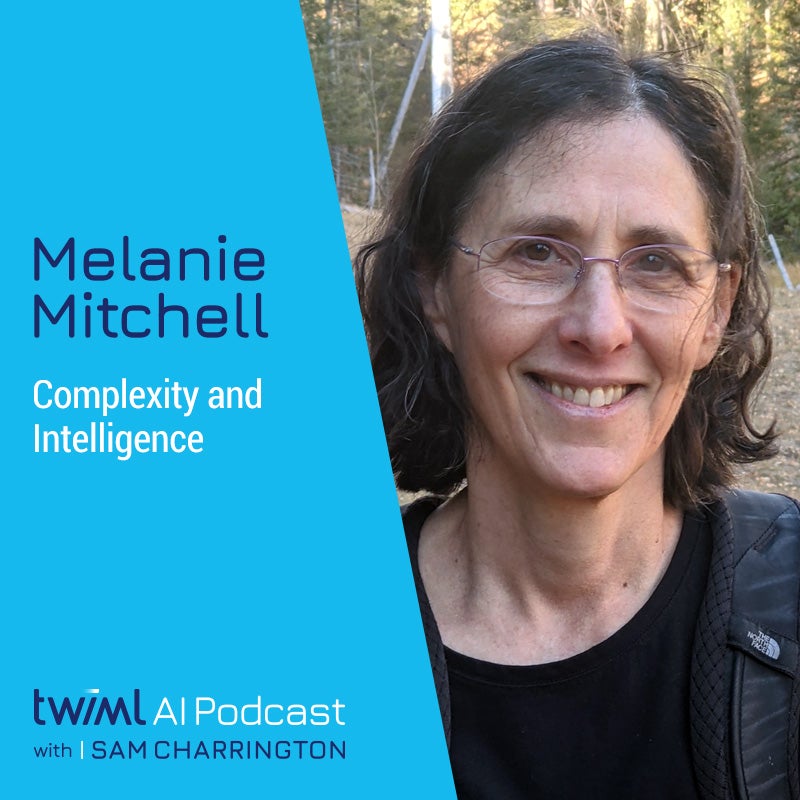
Episode 464 · Season 1
Complexity and Intelligence with Melanie Mitchell - #464
About this episode
Today we’re joined by Melanie Mitchell, Davis Professor at the Santa Fe Institute and author of Artificial Intelligence: A Guide for Thinking Humans.
While Melanie has had a long career with a myriad of research interests, we focus on a few, complex systems and the understanding of intelligence, complexity, and her recent work on getting AI systems to make analogies. We explore examples of social learning, and how it applies to AI contextually, and defining intelligence.
We discuss potential frameworks that would help machines understand analogies, established benchmarks for analogy, and if there is a social learning solution to help machines figure out analogy. Finally we talk through the overall state of AI systems, the progress we’ve made amid the limited concept of social learning, if we’re able to achieve intelligence with current approaches to AI, and much more!
The complete show notes for this episode can be found at twimlai.com/go/464.
More from The TWIML AI Podcast (formerly This Week in Machine Learning & Artificial Intelligence)
In this episode, Thore Graepel, CEO and co-founder of Metis Reasoning and Chair of Machine Learning at UCL, joins us to explore an approach to AI reasoning inspired by his work on AlphaGo. We discuss…
An AI agent can make many model calls to finish a single job. Some need frontier reasoning. Others can run on an open-weight model, and some involve data that has to stay in-house. How do you decide w…
In this episode, Stefano Corazza, head of AI research at Canva, joins us to explore how his team is building custom models and agents around iterative design workflows. We discuss the tradeoffs betwee…
AI can help scientists write code, analyze data, and draft papers. But can it generate the ideas that lead to new discoveries? Richard Socher, former chief scientist at Salesforce, founder of You.com,…
AI agents are becoming accessible to everyone, raising the bar for developers building the next generation of agent products. When capable, general-purpose agents are available out of the box, differe…