
37 - Let It Bleed (PopMed #1)
About this episode
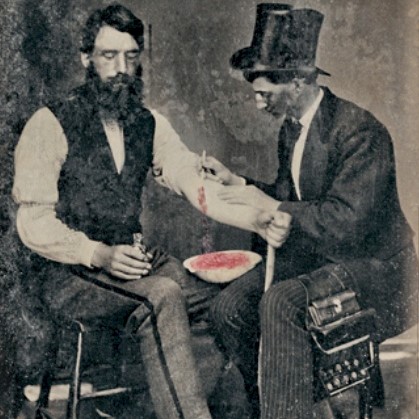
For thousands of years, bloodletting was the standard of care for any number of medical conditions, but at the turn of the nineteenth century, often acrimonious debates about the practice would lead to a new method of medical knowledge. The first of a multi-part series on the birth of population medicine, this episode visits the controversies surrounding the death of George Washington and Benjamin Rush's bleeding of Philadelphia during the 1793 yellow fever epidemic and asks the big question -- how do doctors truly "know" what actually helps their patients? Plus, a brand new #AdamAnswers about military metaphors in medicine. All this and more on Episode 37 of Bedside Rounds, a tiny podcast about fascinating stories in clinical medicine!
Sources:
- Brickell J, Observations on the Medical Treatment of General Washington in His Illness, retrieved from https://books.google.com/books?id=YXA3AQAAMAAJ&pg=PA90&lpg=PA90&dq=craik+dick+washington+medical+repository&source=bl&ots=IZB72sSdaS&sig=kUY0JZHft1HbRrarR9RE4r-2w_A&hl=en&sa=X&ved=2ahUKEwju3PT439TcAhVOxVkKHZPHBVQQ6AEwA3oECAcQAQ#v=onepage&q&f=false
- Cohen B, The death of George Washington (1732-99) and the history of cynanche. J Med Biogr. 2005 Nov;13(4):225-31.
- Craik J and Dick E, The Medical Repository and Review of American Publications on
Surgery, Third Quarter, 1805. - Fuks A, "The Miliary Metaphors of Modern Medicine," 2009.
- Harington J, Regimen Sanitatis Salernitanum (ca. 11th c.), retrieved from https://faculty.humanities.uci.edu/bjbecker/PlaguesandPeople/week3f.html
- Kopperman P, "Venerate the Lancet": Benjamin Rush's Yellow Fever Therapy
in Context. Bulletin of the History of Medicine, Volume 78, Number 3, Fall 2004, pp.
539-574 - Lane HP et al, "The war against dementia: are we battle weary yet?" Age and Ageing, Volume 42, Issue 3, 1 May 2013, Pages 281–283.
- Moed et al, "Cantharidin Revisited: A Blistering Defense of an Ancient Medicine," JAMA Dermatology, October 2001.
- Morens DM, Death of a President, NEJM Dec 9, 1999
- Niehyl PH. The English bloodletting revolution, or modem medicine before 1950. Bull Hist Med 1977; 51, pp. 464-483.
- North RL, "Benjamin Rush, MD: assassin or beloved healer?" Proc (Bayl Univ Med Cent). 2000 Jan; 13(1): 45–49.
- Parapia LA, History of bloodletting by phlebotomy. British Journal of Haematology Volume 143, Issue 4
- Rush, Benjamin. Observations Upon the Origin of the Malignant Bilious, or Yellow Fever in Philadelphia, and Upon the Means of Preventing It: Addressed to the Citizens of Philadelphia. Philadelphia: Printed by Budd and Bartram, for Thomas Dobson, at the Stone House, No. 41, South Second Street., 1799, retrieved from: https://iiif.lib.harvard.edu/manifests/view/drs:6483213$1i
- Wallenborn WM, George Washington's Terminal Illness: A Modern Medical Analysis of the Last Illness and Death of George Washington, retrieved from: http://gwpapers.virginia.edu/history/articles/illness/
More from Bedside Rounds
What does it mean when a computer can make better medical decisions than a human? The progress in large language models, and in particular the popularity of ChatGPT, has brought these questions to the…
What happens when a patient far from surgical care – say, at the bottom of the Pacific ocean on a submarine, or at a research base in Antarctica in the middle of the winter – develops a surgical abdom…
American doctors spend the majority of their time during the day on the computer, either writing or reading notes about their patients; only a small fraction is spent with the human beings in their ca…
In the past episode, cultural and medical historians Lakshmi Krishnan and Mike Neuss discussed the history of the actual work of the doctor – Holmesian detective, data entry clerk, or something else a…
What do doctors actually do? Are they Sherlockian detectives, hunting down obscure clues to solve intractable cases? Are they virtuosic experts, training for half a lifetime to bring the latest scienc…